Platform
A platform for safe, scalable, and
controlled non-viral gene delivery
CellShot integrates non-destructive electroporation, protective buffer architecture, and scalable system design to enable manufacturing-ready non-viral gene delivery.
FEMTOBIOMED CellShot® ND-FFT Technology
Non-Destructive, Scalable Gene Delivery from Transfection to Cryopreservation
Rethinking Gene Delivery for Living Cell Manufacturing
In cell and gene therapy manufacturing, gene delivery is not an isolated step—it directly determines cell health, proliferative capacity, product consistency, and clinical scalability.
While non-viral electroporation is widely used, most conventional systems were designed for delivery efficiency—not for living cell manufacturing.
CellShot’s Non-Destructive Field Flow Transfection (ND-FFT) was developed specifically to close this gap—by redesigning electroporation for living cell manufacturing.
The Fundamental Problem with Conventional Electroporation
Most traditional electroporation platforms share the same design assumptions:
- High electric fields applied in static or semi-static chambers
- Short, intense pulses optimized for single-step delivery
- Minimal consideration for thermal accumulation, metabolic stress, or repeatability
This leads to a common trade-off:
High delivery efficiency → Reduced viability, proliferation, and long-term manufacturing robustness
In early research, this trade-off may be acceptable.
In clinical and commercial manufacturing, it is not.
ND-FFT: A Different Design Philosophy
ND-FFT (Non-Destructive, Field-Flow Transfection) is CellShot’s core design philosophy. By precisely controlling electric fields, temperature, flow, and buffer architecture at the microfluidic level, ND-FFT enables efficient gene delivery while preserving cell viability, functionality, and expandability.
ND-FFT is not an incremental improvement—it is a structural redesign.
ND-FFT Core Architecture for Non-Viral Cell Engineering
ND-FFT is not an incremental improvement—it is a structural redesign.
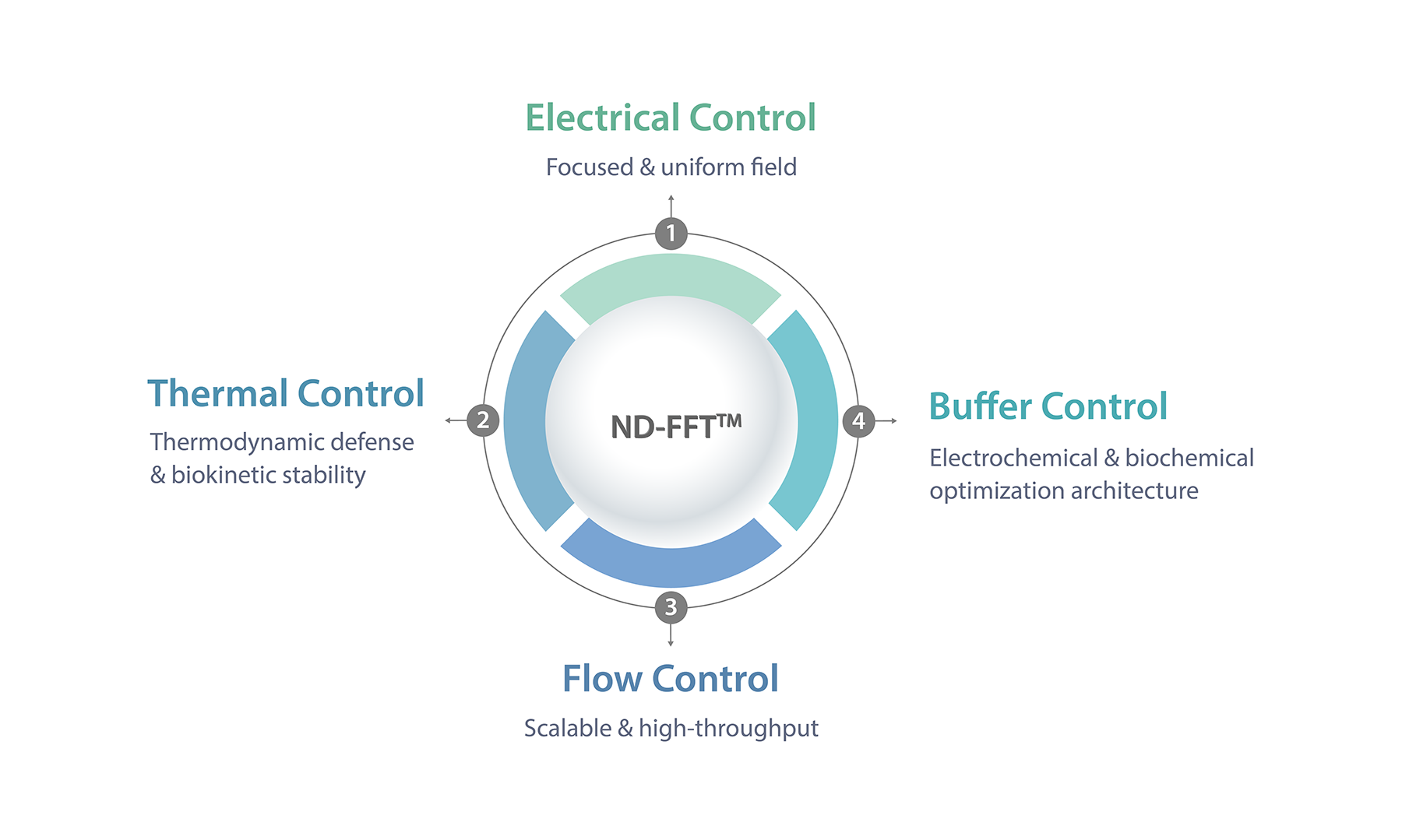
An integrated physical–chemical co-engineering framework for non-viral cell engineering, through precise control of electric field, temperature, buffer architecture, and flow at the microfluidic level.
※ Technology Comparison: ND-FFT vs Conventional Platforms
| Category | Conventional Electroporation | ND-FFT (CellShot®) |
|---|---|---|
| Delivery Mode | Static / cuvette-based | Continuous partitioned flow |
| Thermal Control | Limited or passive | Active, real-time temperature control |
| Cellular Stress | High peak electrical & thermal stress | Distributed, non-destructive exposure |
| Viability Post-EP | Often reduced | Preserved |
| Proliferation Capacity | Frequently compromised | Maintained |
| Repeat Transfection | Not recommended | Enabled |
| Multigene Delivery | Limited by stress accumulation | Designed for multi-step delivery |
| Manufacturing Suitability | Research-centric | Manufacturing-centric |
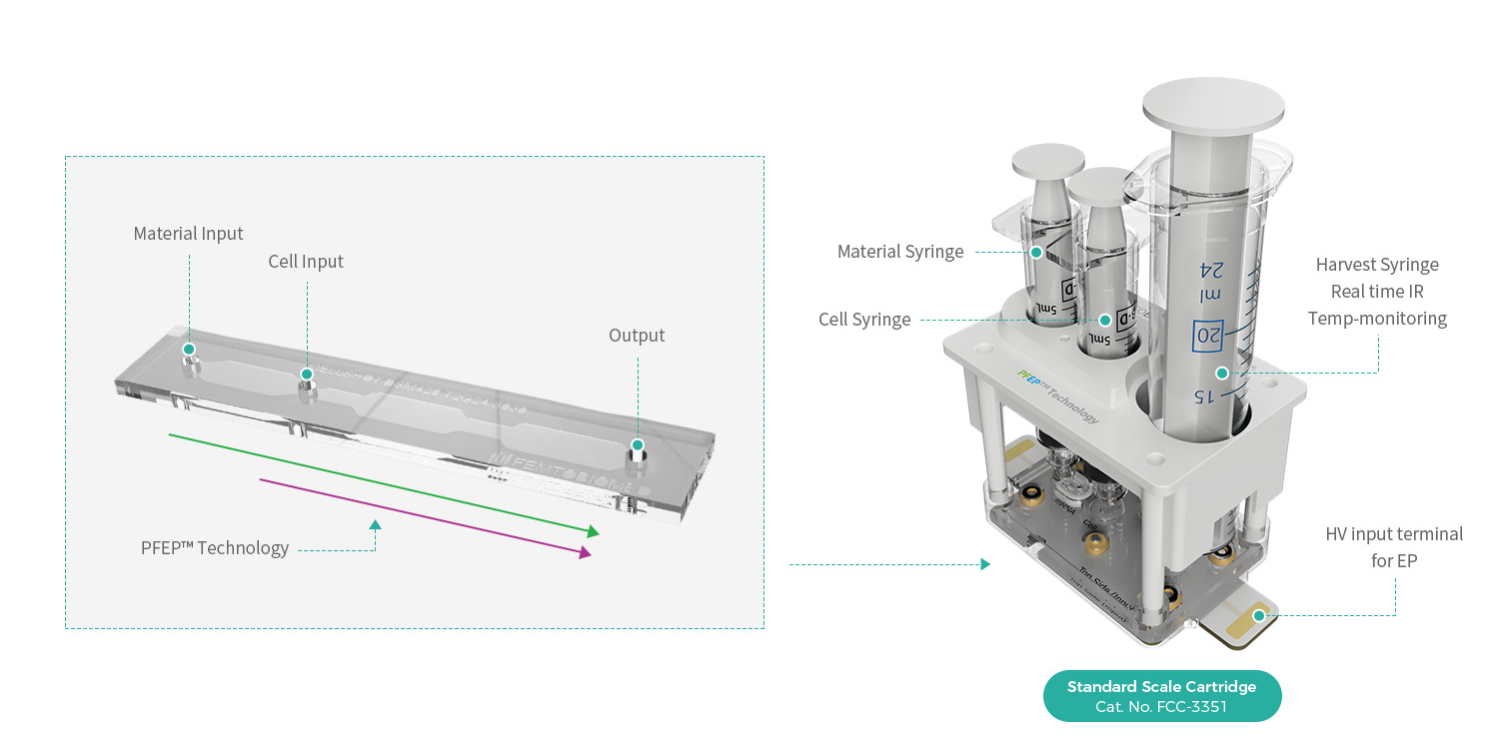
CellShot Cartridge Architecture based on the ND-FFT Design Philosophy
Core Technology: Partitioned-Flow Electroporation (PFEP™)
CellShot® is built on a proprietary Partitioned-Flow Electroporation (PFEP™) architecture that redefines how electric fields interact with living cells. Rather than exposing cells to a single, uniform environment, the CellShot system is designed to functionally separate electrical conduction, thermal management, and cellular exposure during electroporation. This system-level design philosophy enables precise control of the electroporation environment while preserving cell viability and functionality.
Parallel-Flow, Field-Aligned Architecture
Within the CellShot cartridge, fluids are guided through a microfluidic electroporation channel under tightly controlled laminar flow conditions. An electric field is applied along the direction of flow, creating a highly uniform field profile across the processing region. By generating the electric field externally—without embedding electrodes inside the microchannel—CellShot avoids common sources of electrochemical damage, electrode fouling, and field distortion, ensuring reproducible and scalable performance.
Thermal and Chemical Protection by Design
CellShot is engineered to minimize thermal and chemical stress during high-voltage electroporation. The cartridge architecture allows electrical conduction and heat dissipation to be managed independently from the cellular microenvironment, reducing unwanted side effects typically associated with aggressive electrical conditions. As a result, cells experience the electric field required for efficient delivery without unnecessary exposure to damaging thermal or electrochemical stress.
Optimized for Performance, Safety, and Recovery
CellShot enables coordinated optimization across three critical dimensions:
- Delivery performance
- Cellular safety during processing
- Post-electroporation recovery and expansion
- Process Robustness & Reproducibility
This balance is achieved through system-level engineering, rather than reliance on extreme electrical parameters, making CellShot well suited for sensitive payloads such as mRNA, CRISPR RNPs, and other non-viral gene delivery applications.
Designed for Scalable, GMP-Ready Manufacturing
The CellShot cartridge is a closed, single-use system compatible with automated workflows and clinical manufacturing environments. Its architecture supports high-throughput operation while maintaining reproducibility, sterility, and regulatory readiness—from research scale to commercial production.
Three Core Technologies Powering the CellShot® ND-FFT Platform
ND-FFT is not a single technology.
It is a system-level architecture realized through three tightly integrated core technologies.
01 PFEP™ — Non-Destructive Gene Delivery Engine
PFEP™ (Partitioned Flow Electroporation) is the core execution engine of ND-FFT.
It enables low-stress, temperature-controlled gene delivery under continuous flow, providing efficient intracellular delivery while minimizing electrical and thermal damage—making repeatable and scalable transfection reliable and manufacturable at production scale.
02 Proliva™ — Immediate Cellular Protection & Recovery
Proliva™ is a GMP-ready protective buffer architecture, engineered to stabilize cells during and immediately after electroporation.
By preserving membrane integrity and mitochondrial function, Proliva™ supports high post-transfection viability, proliferation capacity, and functional stability, even under multi-step or sequential delivery workflows.
03 Cryoliva™ — Manufacturing-Ready Cryopreservation Continuity
Cryoliva™ extends the ND-FFT philosophy beyond transfection into downstream processing.
Optimized for low-DMSO cryopreservation, Cryoliva™ enables robust post-thaw recovery and ensures end-to-end process continuity—from gene delivery through storage, supporting scalable, multi-batch manufacturing workflows.
The CellShot platform is built on an FDA DMF-registered technology framework (DMF #30803), enabling consistent cell health, enhanced gene expression, and repeatable, sequential transfection workflows required for advanced cell and gene therapy manufacturing—while maintaining full cellular vitality.
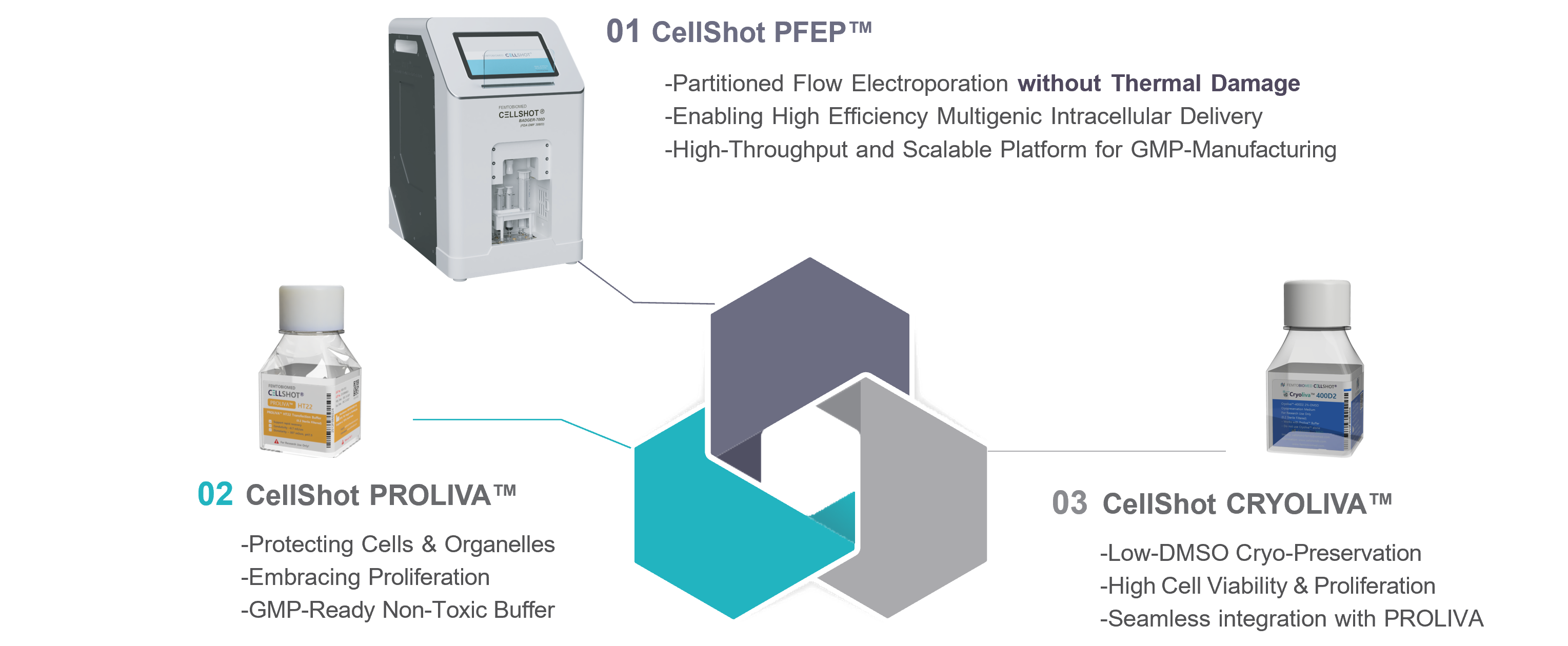
These three technologies come together as a unified, manufacturing-ready system—designed to operate as part of the CellShot Suite.
ND-FFT Is Built for Manufacturing, Not Just Delivery
ND-FFT was designed from the outset to integrate with:
- Closed or conditionally closed GMP workflows
- Automated process control and traceability
- Regulatory documentation and inspection requirements
This is why ND-FFT serves as the core engine of the CellShot Platform—and why it scales naturally from research to clinical and commercial manufacturing.
Electroporation should not be a trade-off between delivery efficiency and long-term cell health.